How to Ask AI Good Questions — A Prompt Formula Even Beginners Can Use
Same ChatGPT — so why do some people get useless answers while others get ready-to-use ones?
The difference is just one thing — how you ask. The good news: it's not talent, it's a formula.
Memorize this one formula and your answer quality changes starting today. What's the formula? Right below. 👇
❌ Result of a vague question
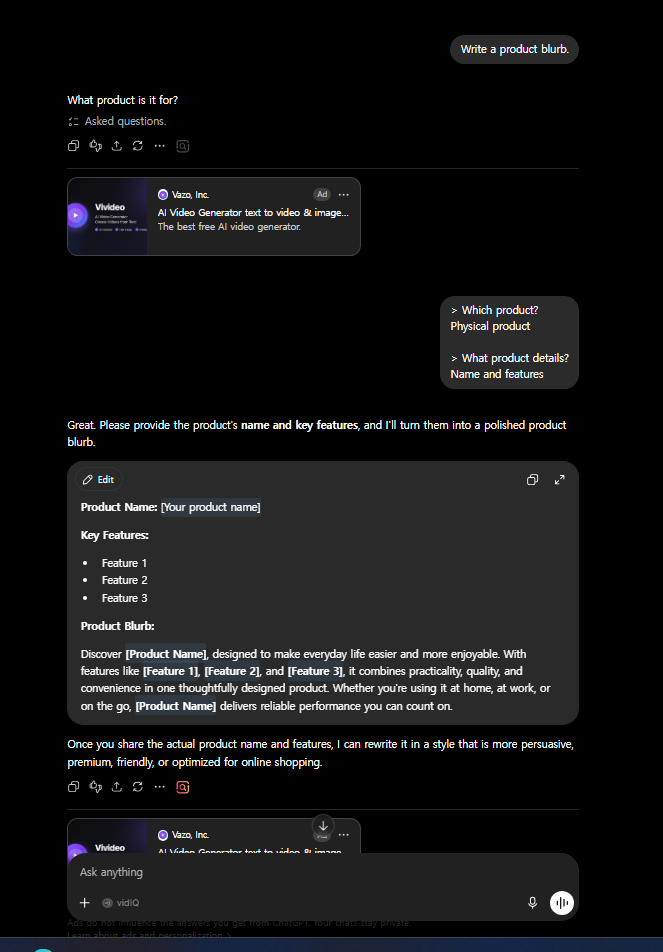
✅ Result using the formula
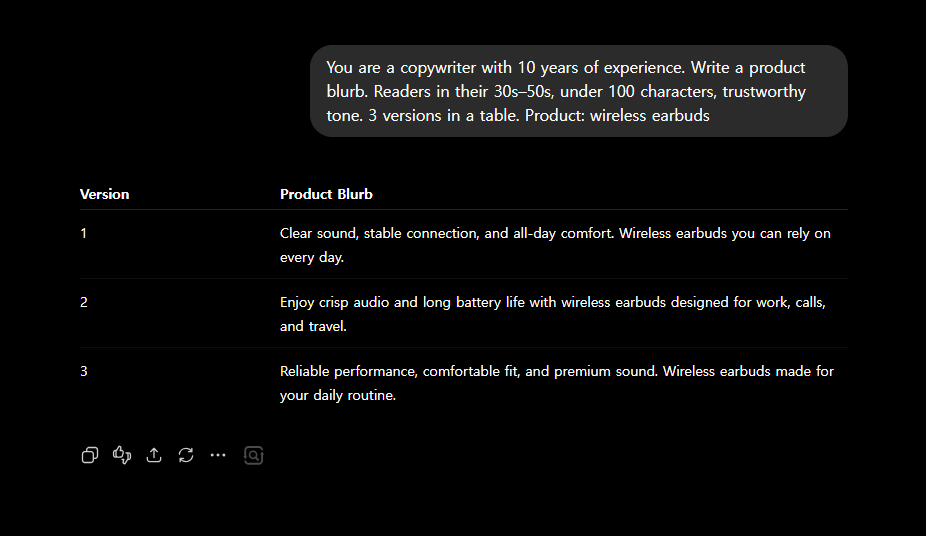
First, why the gap is so big
AI answers only as much as you give it.
- "write something" → vague fluff
- "to whom, for what purpose, how long, what tone" → a ready-to-use answer
So a good answer = a good question. The formula for that good question is exactly 4 steps. 👇
The 4-step prompt formula (this is all you need)
① Role + ② Task + ③ Conditions + ④ Format
- ① Role — "You are a copywriter with 10 years of experience"
- ② Task — "Write a product blurb"
- ③ Conditions — "For readers in their 30s–50s, under 100 characters, trustworthy tone"
- ④ Format — "Give 3 versions in a table"
Put together?
You are a copywriter with 10 years of experience. Write a product blurb.
For readers in their 30s–50s, under 100 characters, in a trustworthy tone.
Give 3 versions organized in a table.

Product: [describe the product here]
That small difference changes the answer completely. So do you have to build this every time? No — here are copy-paste templates. 👇
7 copy-paste templates (by task)
Copy the one you need and just swap the brackets.
1. Work email → Rewrite the below as a polite work email. Recipient is [client/boss], within [length]: [content]
2. Document summary → Summarize this in 5 lines + 3 key points + 1 easy-to-miss point: [document]
3. Ideas → 10 ideas on [topic]. Most original first, one line each, in a table.
4. Draft → A blog draft on [topic]. Readers in their 30s–50s, 5 H2s, 3–4 sentences per paragraph, plain language.
5. Translate + polish → Translate the below into English, naturally, as a native would write: [text]
6. Compare → Compare [A] and [B] on 5 criteria in a table. End with a one-line recommendation.
7. Explain simply → Explain [concept] so a middle-schooler gets it, using an analogy.
Put in a template and the answer still falls short? There's a trick for that. 👇
When the answer falls short — the "ask again" magic
Don't expect perfection in one shot. AI's real power is conversation.
- "shorter" / "more polite" / "more examples"
- "turn that last answer into a table"
- "develop version 3 further"
The more you go back and forth, the better it gets. Add three pro tips and you're set. 👇
3 pro tips
- Give an example — one line of "like this: [example]" raises quality a lot
- Ask in steps — "outline first, then the body once I approve"
- Set the shape — specify the output format (table, numbers, bullets)
Now you too are "good at asking." Try just one for real today.
Bad question → good question: 5 real pairs
If the formula still feels hard, just get these 5 pairs into your eye. Swap what you'd write on the left for the right, and you're done.
| ❌ Like this (vague) | ✅ Like this (a ready-to-use answer) |
|---|---|
| Write an email | An email asking a client to postpone the meeting, polite, in 3 lines |
| Summarize this article | Summarize this in 5 lines + 3 key points + 1 easy-to-miss point |
| Give me marketing ideas | 10 Instagram ideas for a cafe targeting women in their 30s–40s, in a table |
| Fix this | Make this sentence shorter and softer, so a grade-schooler gets it |
| Plan a trip | A 3-day, 2-night San Diego itinerary, couple + beach focused, with travel times |
💡 See the common thread? Adding who, what, how much, and what format. That's all it is.
FAQ
Q. Is English better to ask in? These days your own language is plenty. Use whatever's comfortable.
Q. Does it have to be long? Specificity beats length. Short is fine if the conditions are clear.
Q. Tired of building it each time? Save the templates above in a notes app and paste them.
Read next
Hashtags: #prompts #howtouseChatGPT #usingAI #promptengineering #productivity